Phoenix Art Museum : Continuing Education Lecture
Eric Fischl Vanguard Winner : Adam Corona talks about “Whats Next?”
This conversation has been recorded by The Phoenix Art Museum as part of the “Continuing Education” lecture series, and transcribed by BrassTuna.
(This conversation has been edited for length and clarity)
Conversation held at the Phoenix Art Museum on September 8th, 2025
Adam Corona: “Hi everybody, I'm Adam Corona, also known as BrassTuna.
Also ,,, I may look familiar to some of you, as I do work here at the Phoenix Art Museum, so I am honored to be here ,,,, on my day off, haha.”
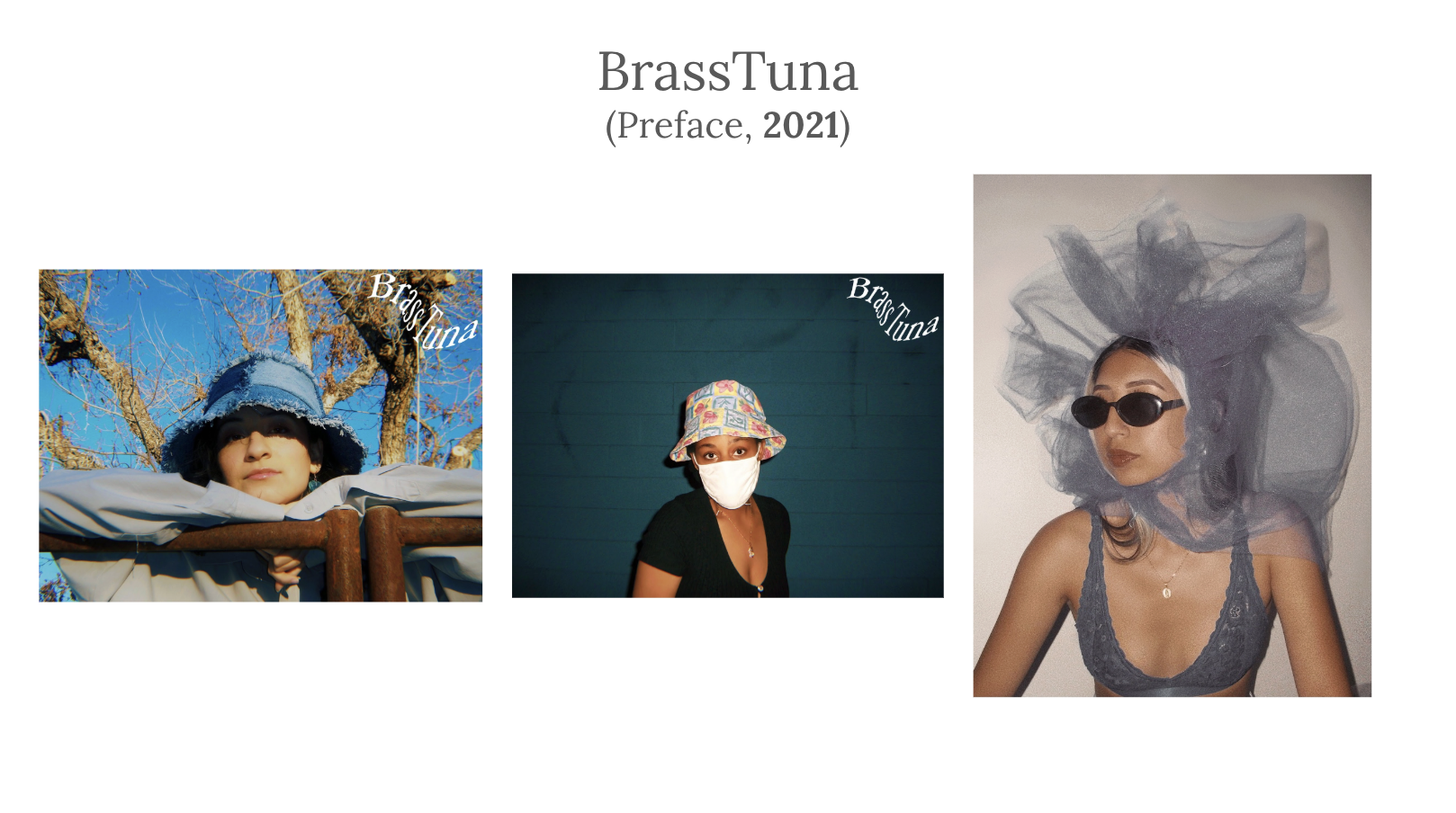
(Preface 2021 , images included in lecture slideshow)
Adam Corona: “I’m a photographer ,,, I've kind of had to come to terms with that.
I feel like often times, I've been put in a box of ‘what type of artist’ I am. And, over the course of me doing photography, I've really explored different avenues ,,, and these three works here [Preface 2021] are some of my earliest from 2021.
I wouldn’t say that these are my earliest, but in terms of me doing BrassTuna, these are some of my earliest.
When I first started BrassTuna, I was sewing a lot.
I was in school for fashion, so I was really interested in making headpieces and clothing, and photographing my friends wearing them.
And then over the course of me photographing my friends, it turned into me just doing photography.
And then people asking me to take photos of them.”
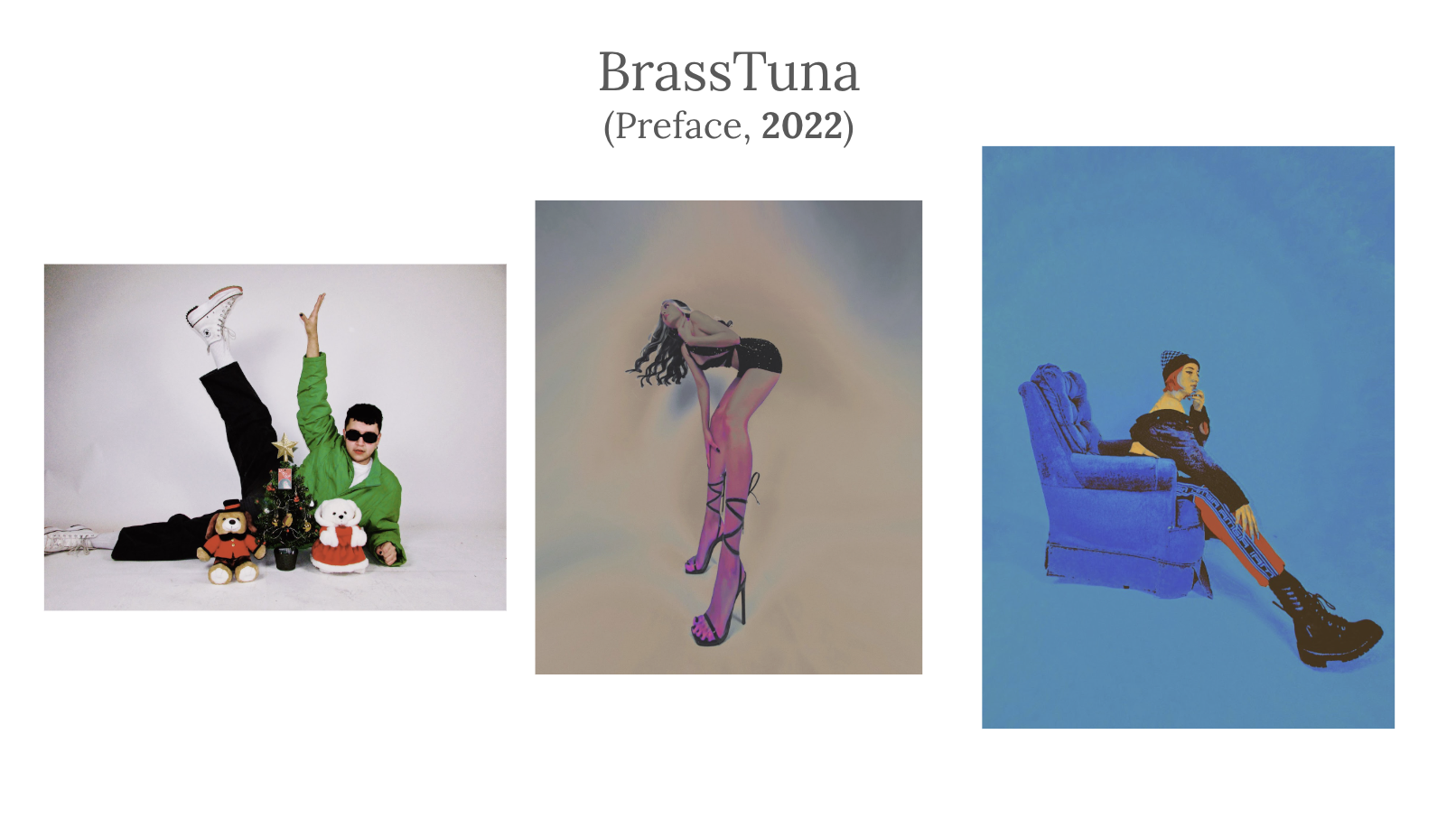
(Preface 2022 , images included in lecture slideshow)
Adam Corona: “So I included different chapters ,,,
I like to call them chapters, and for some of them, there are two chapters in one year.
It's kind of like a ‘self-discovery’ moment where I felt like I was going down a different road.
And so, these three here [Preface 2022] kind of represent that next point of view that I had.
So I was shifting from creating clothing items ,,, to photographing myself and my friends for their birthdays.
And I was really influenced by Instagram and different digital media, and it wasn't until later down the line that I found other inspirations.”
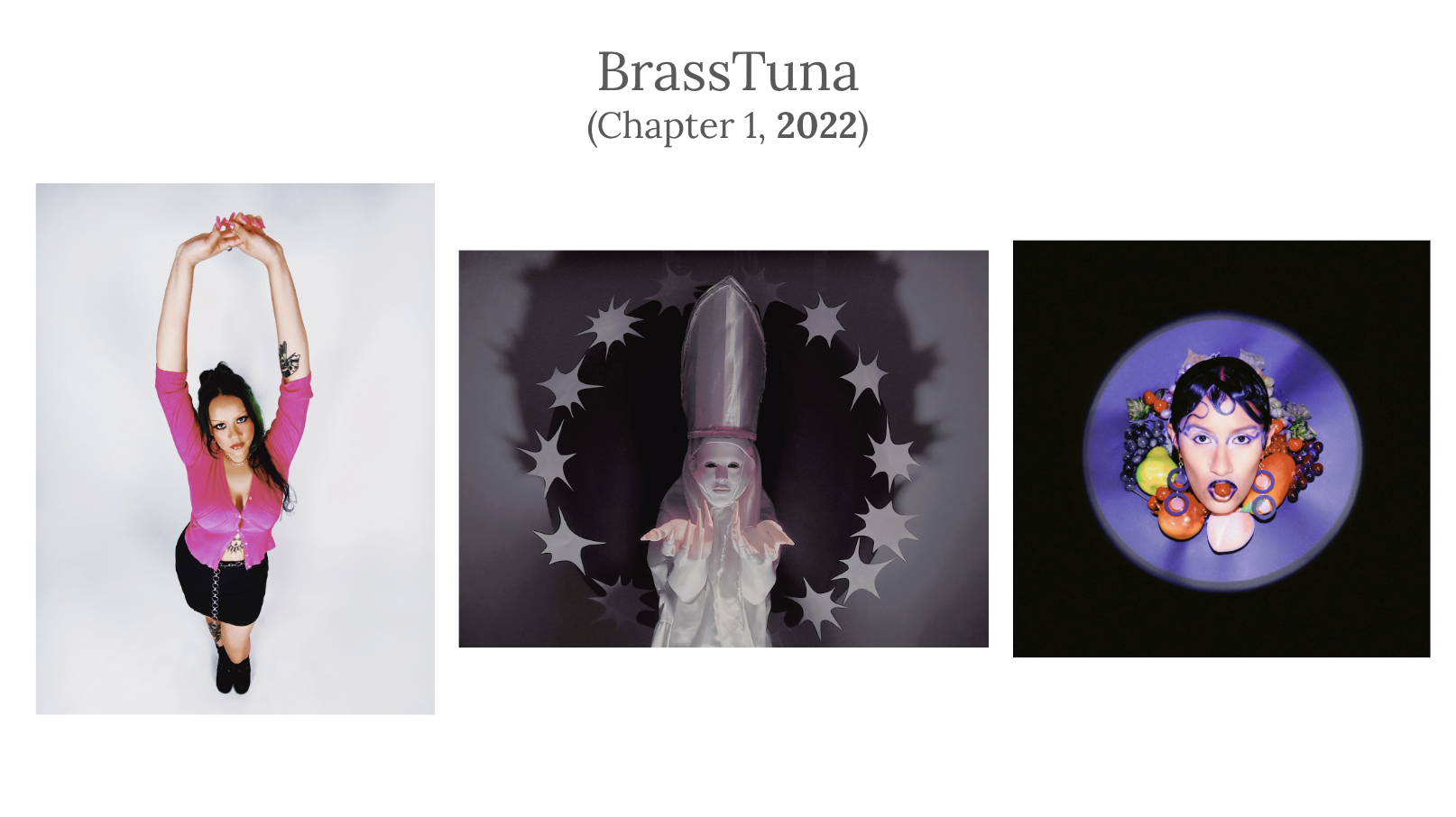
(Chapter 1 , images included in lecture slideshow)
Adam Corona: “So this is again [Chapter 1] continuing on with this idea of playing with different imagery that I would see online, and so ,,,
The middle one in this set of images was one of the first ones where I kind of started to push myself ,,, and I had ideas of Mexican iconography.
I was just playing with these ideas of painting my model's skin white and ,,,
All of these people are my friends, so I would just invite them over, and at this time I wasn’t working here at the museum ,,, I was working at another job.
And I just spent all my money on things from Amazon to do these photo shoots, such as the fruit one that you see.”
“I bought this fake fruit from Amazon, and I was like:
‘OK, I have this idea ,,, let's see if we can pull it off.’
And I cut a hole in my seamless paper backdrop, and I glued these fake fruits to it, and my friend did my model's makeup and hair.
I was just telling her: ‘Just ,,, try and not break the backdrop!’ haha.”
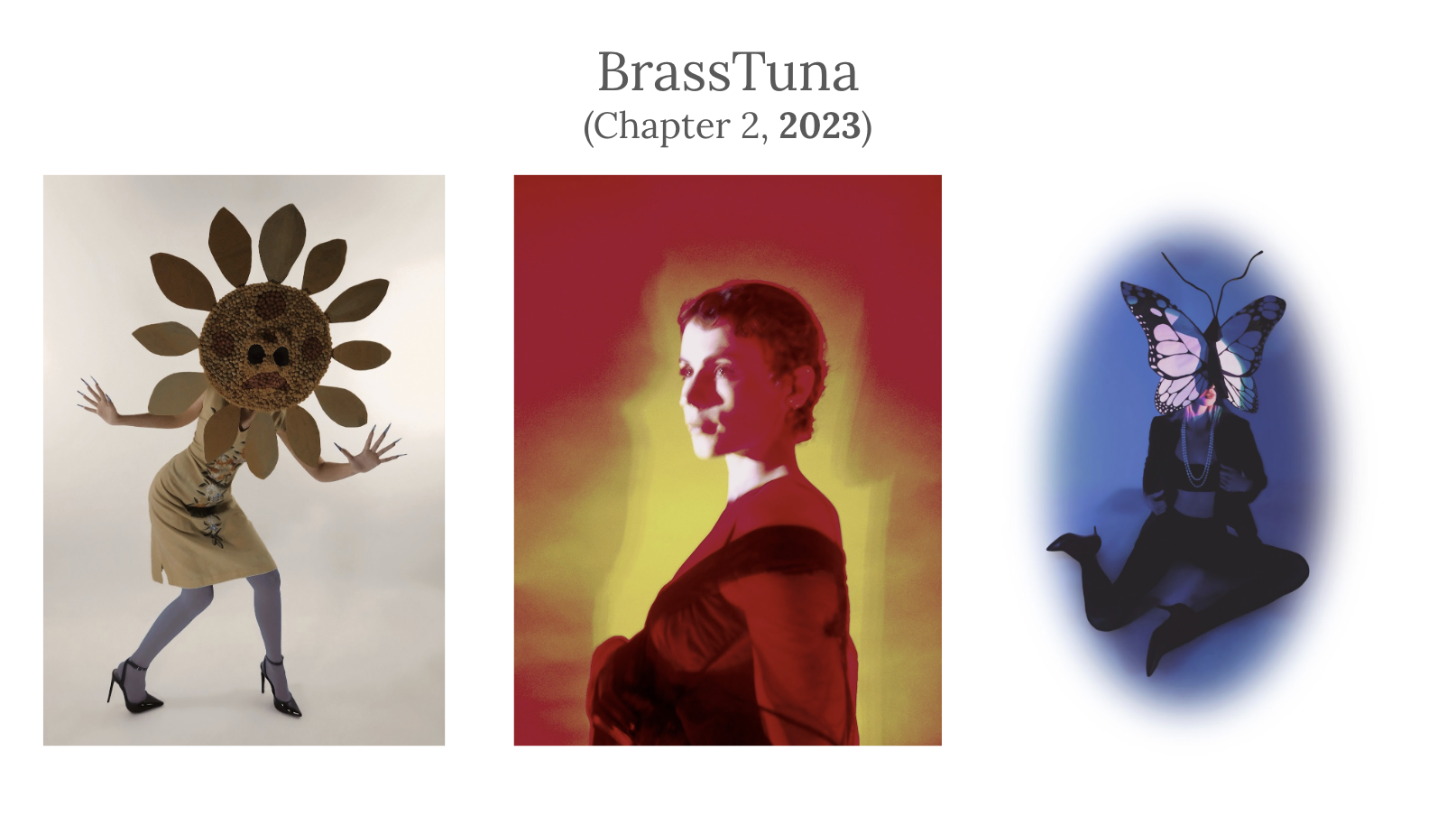
(Chapter 2 , images included in lecture slideshow)
Adam Corona: “Then we get to,,,
I would say that this chapter [Chapter 2] in 2023 was kind of like ,,, a very pivotal moment for me.
It was the first time that I really mixed my Mexican-American identity into my work.
And in the first photo that you see with the large flower mask, this is when it really took a turn for me.”
“This is part of a much larger series that I worked on called ‘Jardin de Flores,' where I handmade these masks that were inspired by Mexican iconography, and the stories I was raised around.
And also AI ,,, I had seen these weird AI videos and I was like, ‘you know, this would be a little more interesting if someone made it by hand.’
So I used that as inspiration, and I made these huge masks, and I learned so much since then.”
“Like, this mask, for example, must weigh a ton.
If you look closely at it, there are hand-rolled balls of tissue paper.
I don’t know how many there are; I haven't done the math, but I worked for two weeks on it, to try and get these images.
I remember my hands were stained yellow and red from the different tissue paper balls.
And I’ve learned a lot since making this specific mask.
Sometimes I’ll have my sister put it on ,,,”
“Oh, that’s my sister in the picture by the way ,,,
And we will re-shoot it, and her face turns red, and she's sweating, haha.
She’s the only one I can have wear this mask because ,,, I feel so bad because it weighs so much and it's so crappily made, haha.”
“All the materials I use are 'unconventional' materials.
I don’t believe that they are unconventional to me anymore though.
I use pizza boxes, for example, this mask was made from a Costco pizza box.
That’s the base of it. And then I started piling a bunch of junk on top of it.”
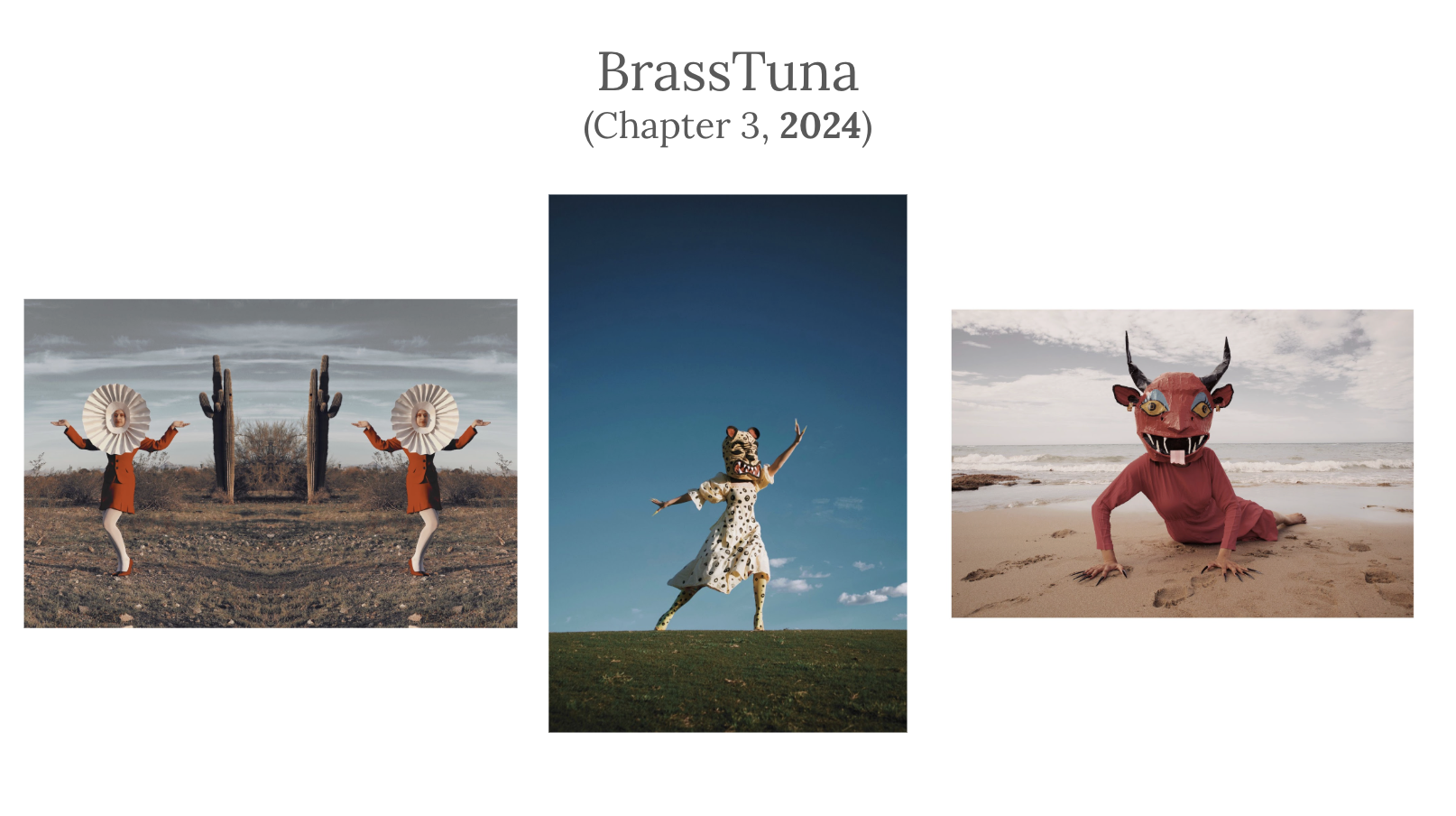
(Chapter 3, 2024 , images included in lecture slideshow)
Adam Corona: “Then we get to where, I believe, I began understanding who I was as an artist. [Chapter 3, 2024]
Where with ‘Jardin de Flores,’ I included over 30 individuals from Phoenix, I had put a call out on my Instagram, where I then included people from different Latin American backgrounds.
It was that community involvement, within my specific community of Latin Americans ,,,
Who feel like sometimes our voices aren't always heard ,,, that made me want to dive deeper into it.”
“That brings us to these three. [Chapter 3, 2024]
The first image you see here is the image that won the Vanguard.
It’s a handmade mask that I made using leftover seamless paper that I had lying around, that I didn’t want to throw away.
The middle one ,,, won first place that same year, and in the photo is my sister again.
As you can tell, I put her through a lot, haha.
We can deal with each other, so I really appreciate her.
Again, it's just all handmade masks, using literally just trash ,,, and just trying my best to manipulate the materials in front of me.
And I think that was a really big lesson that was taught to me when I was young.
Especially as a Mexican American, that rasquache way of creating and making do with what you have.
All of the garments you see here are thrifted as well.”
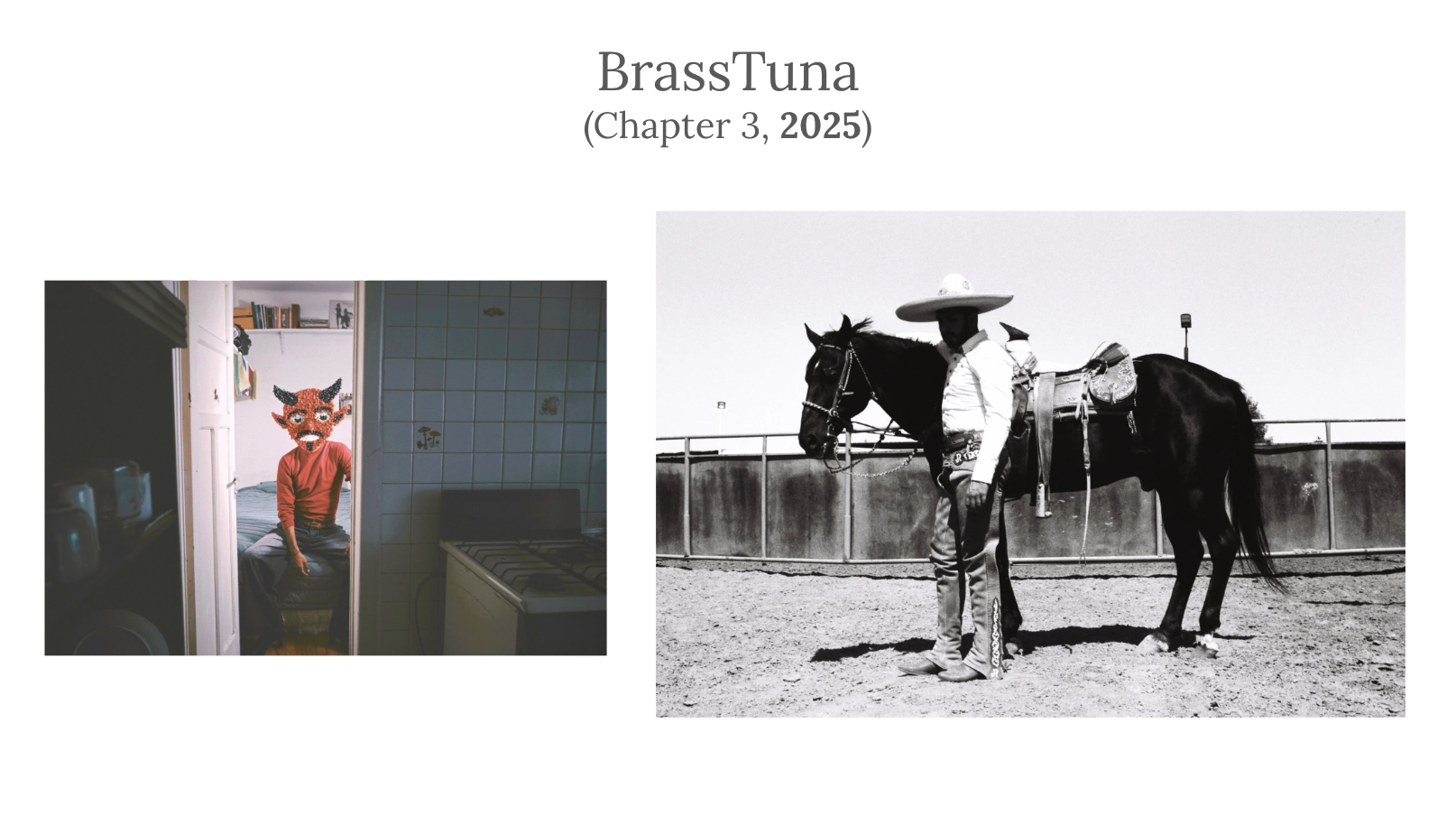
(Chapter 3, 2025 , images included in lecture slideshow)
Adam Corona: “And that brings us to this year. [Chapter 3, 2025]
This year was a very, very monumental year for me.
After winning the Eric Fischl Vanguard award, I applied for the Phoenix Artists to Work grant, which is one of the largest grants for artists in Phoenix.
These two images [Chapter 3, 2025] here are some of the only ones I created this year, because I ended up getting the grant, and with that grant, I decided to host my first-ever solo exhibition.”
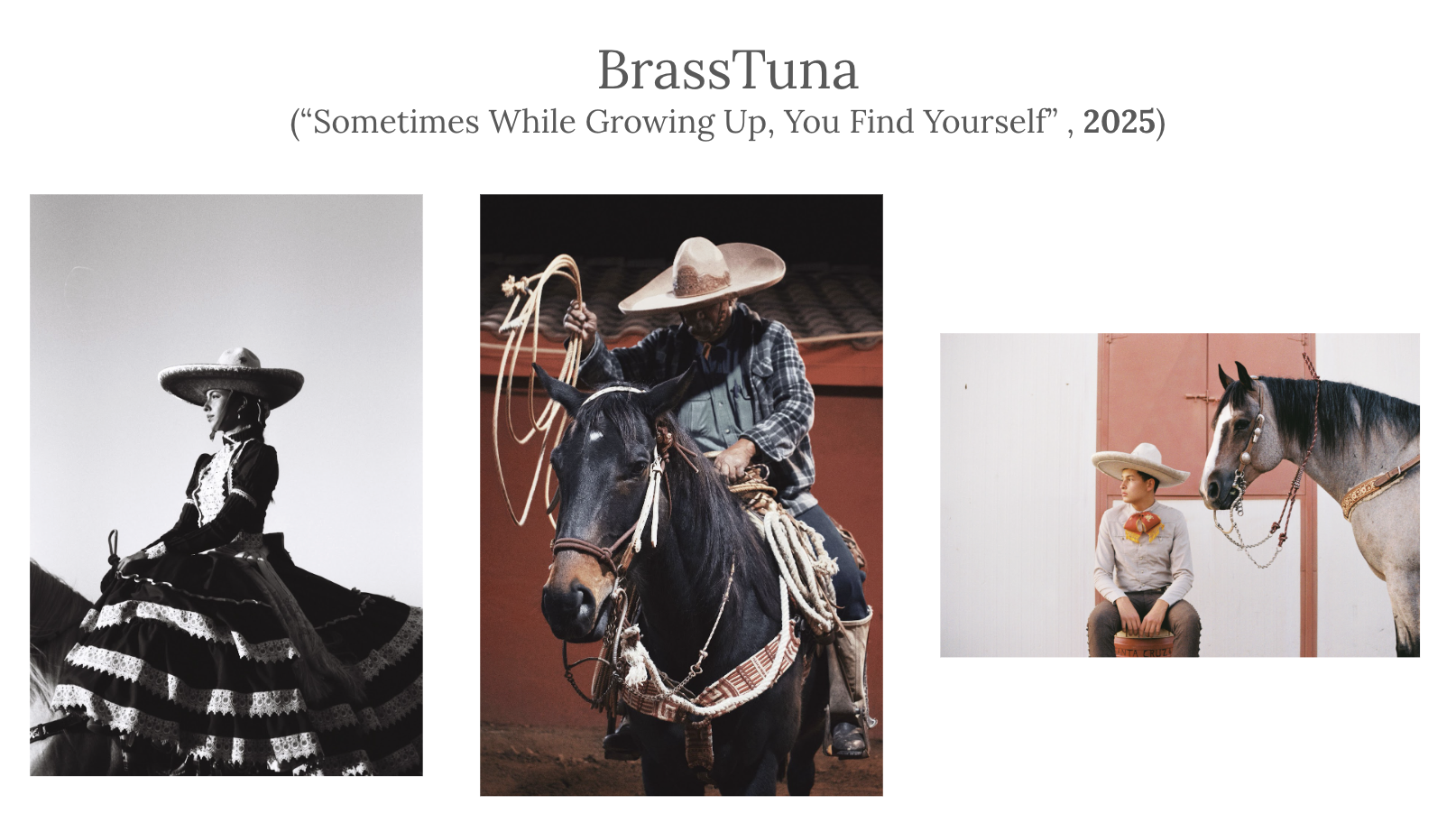
(images included in lecture slideshow)
Adam Corona: “So here are three images from my newest body of work.
Only one of them will be in the show itself; the other two are not.
I won't tell you which ones are not; you’ll have to come to the show and find out, haha.
But the story here ,,,
The title of the show, “Sometimes While Growing Up, You Find Yourself,” ,,,
I knew that if I got such a big opportunity to showcase my work, I wanted it to be something that would uplift my community, as well as uplift me.
My background with the Charrería, which is the sport that you see here ,,, actually it's a very long story, haha.
,,, But I knew that as I continued growing up, I wanted to come back to self, and identity, and reflection, and all of the lessons that I had learned throughout my life.
And so for the past nine months, my team and I ,,, who I hired with the help of the grant ,,,”
“Well, I actually got the team together before I applied for the grant, because I knew I needed a team of individuals if I wanted to pull this off.
But for the past nine months, my team and I have been working with eight participants in South Phoenix who participate in the charrería, and it was very scary.
Going back into a community that I was once a part of, that I kind of distanced myself from ,,, out of shame and anger.
But it's been a very healing process.”
“So it's a photo documentary exhibition about these eight participants ,,, and it's been the most life-changing opportunity for me.
To go back and to ‘right the wrong’ of my past, and combine that with the newfound skills that I have learned from school and from exploring my own artistic identity.”
Jay Hardin: “The Phoenix College Vanguard Awards that we do every year are a huge thing for our students.
And from my perspective ,,, I see a huge transformation that happens when students are preparing their works and exhibiting them.
And for these artists to be awarded by Eric and other prominent artists from around the world, it's really an amazing thing, and I see a lot of transformation in my students.
I just wanted to know if you all had anything you’d like to share about the process, or maybe the impact, or the confidence that maybe it’s given you within your work from the Vanguard Award.”
Adam Corona: “Yeah, I had mentioned that after I had gotten the Vanguard award ,,, and first place, same year, haha.
Well, originally, I wasn’t going to apply for the Vanguard award, and my professors were like, ‘No, you are going to apply for it, we are going to grade you on it if you don’t.’
So shout out to Jen from PC, haha.
It gave me a sense of confidence that I then applied for the artists to work grant and ended up getting it. I was so determined.
I think it was also the actual reception of the vanguard, too, since it's held at the museum, and I work here.
I don’t know, it was such a strange moment for me.
Getting to talk with some of the curators and just being seen as an artist in this space, it's really impactful.
It really just changed my perception of like ‘Oh, well maybe I can apply for big things and get them.’
And maybe they are attainable to people like me.
So I think that's the impact of the vanguard on me.”
Jay Hardin: “I was also curious to know if,
All of you have very different work, very different content, and there's always the balance between making it for yourself, personally. And also sharing it with an audience and sharing it with your community.
And making a career out of it, trying to make money at this thing that you love and that you're passionate about.
I was curious if you all could speak a little about the balance between those two worlds.
Of the personal side, and pursuing it as a career, if you have ambitions to pursue it as a career?”
Adam Corona: “Hmm, that's a pretty difficult question.
I feel like, again, here I go talking about my show, haha.
This project that I've been working on over the past year now ,,, again, it's really changed my perspective as to who I am, and what I want to do with my art.
And where I plan to go with it.
I think when I look at the development of my artistic path ,,, it was always meant to come back to community.
It was always meant to document the individuals who I was surrounded by and who I grew up around, who weren't always given the opportunity.”
“You know, that was one of the big things for me when applying for this grant.
The goal was to platform a group of individuals that I had never seen ,,,
You know I have worked here at the Phoenix Art Museum for over two years, and I love it here, but I have not seen the representation of my community, who are basically just down the street from here.”
“And that to me ,,,
You know, I could sit here and say ‘I hope I become successful, and I hope I make money,’ but right now in this moment, I hope to create at least a small amount of change in my community so they can view themselves in a way that maybe they haven't before.”
“And the response that I've gotten from the participants so far, to hear them say, ‘I've never seen this before.’
When I first came back to the community and introduced myself to them, I felt very scared.
The relationships that we had to navigate. I knew from the beginning I had to build authentic relationships with my participants.
And nine months later to speak with them ,,, to get their responses, it's just ,,,
Some of the young ones ,,, some are 16 years old, and to get their response like ‘Oh my god, that's sick!’
That, to me, is what I want to do with my art.
I don't know what path that will lead me down, I don't know where that will take me, but I know that if I have the free time, I will continue to do things like this. And try and create a sense of change within my community.”
Audience Question: “I'm just curious about the name ‘BrassTuna.’
Where did that come from?”
Adam Corona: “Haha, I think that's probably my most asked question.
Well, first of all, I'll say that it took me a long time to be comfortable being called ‘BrassTuna’ or even saying that.
The name came to me, and I felt so ashamed of it.
My mom would ask me what BrassTuna was, and I'd tell her, ‘Don't say that, don't say that out loud.’
The name ,,, it's interesting how I feel like this foundation has been in my life forever, and it's like I'm uncovering a fossil.”
“When I was five, I went on a trip with my family to visit some of our other family in Mexico.
I remember we were walking through a mercado, and there were a bunch of little shops, and there was this one in particular, and it was a metalworking shop.”
“And before this ,,, one of the first words I had ever learned to say was marine biology.
I wanted to be a marine biologist so bad ,,, but living in Arizona ,,, it has its difficulties, and if I could do life over again, I'd probably go to school to be a marine biologist.”
“I remember walking past this shop with my parents, and it was very rasquache.
Like there were a bunch of men working ,,, a bunch of scrap pieces of metal ,,, they were making wall hangings.
In a bunch of different shapes, like the sun, the moon, a tiger, and a lion.
But I remember there was a Tuna fish on the wall, and I was like, ‘I want that!’
And if you're in Mexico, and if you have a kid with you and they point at something in a store,
oh, they are going to come up to you and sell it to you. There's no way you can get out of that.
So my parents ended up buying it for me, and it became my first material item that I really fell in love with.”
“We had brought it back home, and throughout my teenage years, I would hang it up in my room, and take it down, and put it up over here and take it down, and put it back up over there, and take it down.
And I don't know, I must have been in high school ,,, but I lost it.
It's gone now ,,, I know ,,, haha.
But it just represents a lot to me. It was made very rasquache; it was made with scrap pieces of metal, it's kind of like my art practice, where it's made sometimes with a ‘bunch of trash.’
All of these things ,,, it took my entire life to get to this point.
To really understand that all of these key elements were there all along.”
BrassTuna would like to send a special thanks to the Phoenix Art Museum docent “Continuing Education” lecture series and to this lecture’s host, Jay Hardin.
(This conversation has been edited for length and clarity)Conversation held at the Phoenix Art Museum on September 8th, 2025